Periods of high temperatures and water scarcity are increasing the importance of efficient water management across Europe. According to the European Environment Agency, water scarcity affects around 30% of EU territory and 33% of the population during at least one quarter of the year.
In companies and larger buildings, however, normal water consumption may not be the biggest issue. Hidden leaks and water use outside expected operating hours can be much more significant. These may include a leaking toilet, a pipe leak or malfunctioning equipment. In larger facilities, such problems can continue unnoticed for long periods.
A monthly water bill only shows total consumption. It does not reveal when a problem started, how long it lasted or in which part of the facility it occurred. Continuous water consumption monitoring therefore makes it possible to detect unusual consumption earlier and reduce unnecessary costs as well as the risk of damage.
How to Detect Water Leaks
Even a seemingly minor fault can result in significant water losses. According to the U.S. Environmental Protection Agency’s WaterSense programme, a moderately leaking toilet can waste around 8,600 gallons, or approximately 32.6 m³ of water per month. In the case of a more serious fault, such as a stuck fill valve, water loss can reach 4,300 gallons, or approximately 16.3 m³, in a single day.
In larger buildings with multiple sanitary facilities, distribution lines and water-consuming equipment or processes, an unnoticed problem can therefore add up quickly. This is why detecting unusual consumption early can make a significant difference.
A dripping tap can also add up over time. According to EPA WaterSense, a tap dripping approximately once per second can waste more than 3,000 gallons, or around 11.4 m³ of water per year.
Possible warning signs include:
- continuous water consumption during night-time hours,
- consumption during weekends or shutdown periods,
- a sudden increase without any change in operations,
- gradually increasing baseline consumption,
- significant differences between similar buildings or facilities.
Higher consumption does not always indicate a fault. It may, for example, be related to building occupancy or changes in production. Water consumption therefore needs to be evaluated in the context of the conditions under which the facility operates.
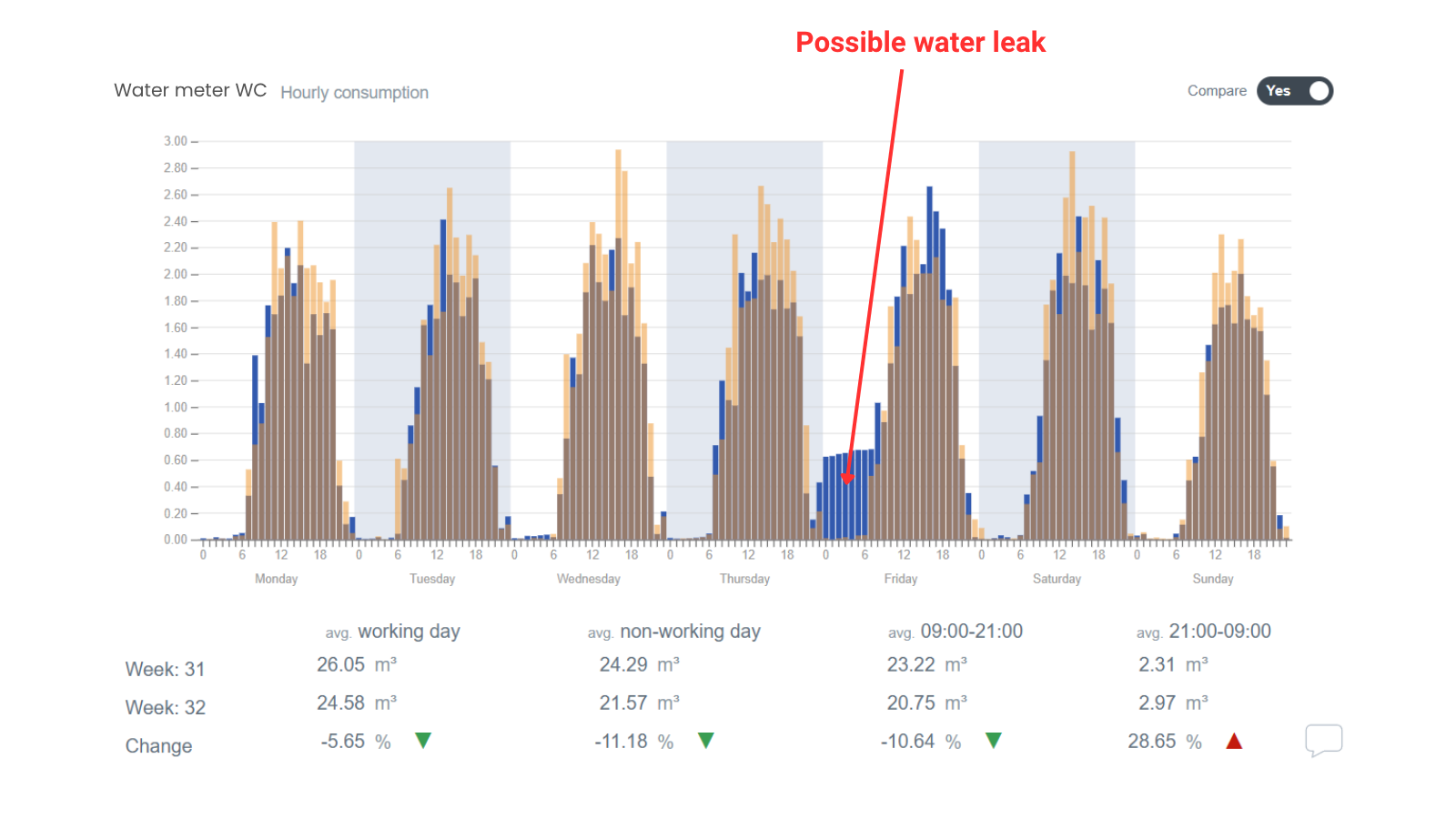
Continuous water consumption outside normal operating hours may indicate a possible water leak.
Why Meter Readings Alone Are Not Enough
A water meter reading shows how much water was consumed over a certain period. However, it does not show when the consumption occurred or in which part of the facility it originated.
Smart water metering and water submetering can provide much more detailed information than occasional meter readings. Continuous data from main and sub-meters makes it possible to monitor consumption at shorter intervals and divide it between individual buildings, operational areas or technologies.
This makes it easier to distinguish normal consumption from unusual usage and to identify more quickly where a potential problem may be occurring.
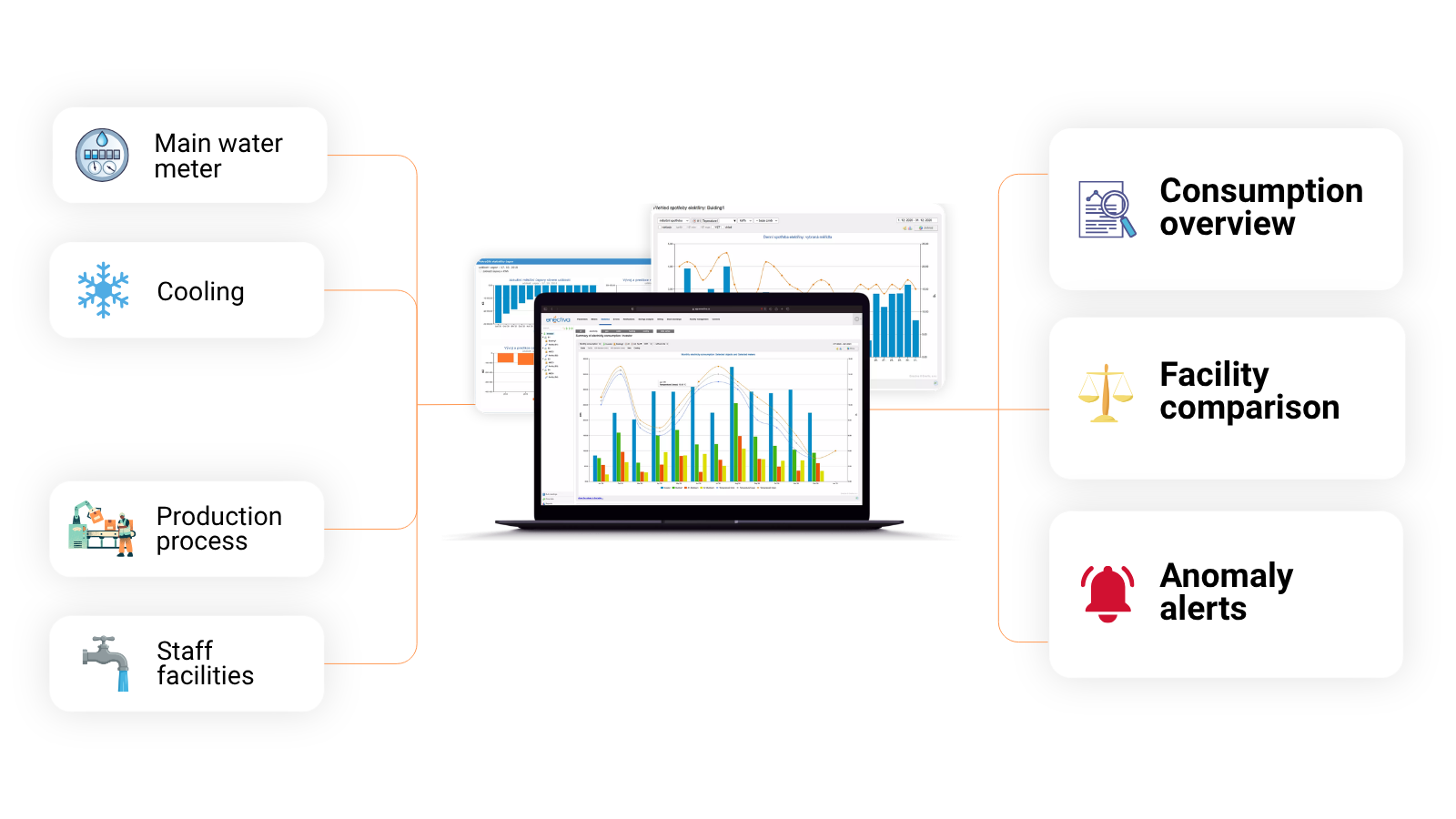
Sub-metering helps monitor water consumption in different parts of a facility and makes it easier to detect unusual consumption earlier.
Higher Consumption Does Not Always Indicate a Problem
During periods of high temperatures, water consumption may naturally increase due to greater use of cooling systems, irrigation or other technological processes.
Higher consumption can also be caused by changes in building occupancy, production levels or operating schedules. An increase in water use therefore does not automatically indicate a leak.
This is why water consumption should always be evaluated in the context of weather and operating conditions. Comparing these factors with actual consumption patterns helps distinguish an expected increase from an unusual pattern that may require further investigation.
How Enectiva Helps Detect Unusual Water Consumption
Enectiva makes it possible to continuously monitor data from both main and sub-meters and compare consumption across different periods, buildings or equipment.
Automatic alerts can be configured when predefined consumption or cost thresholds are exceeded and delivered by email or SMS. This allows the responsible person to investigate the cause before unusual consumption results in higher costs, causes damage or disrupts operations.
We show how to configure these alerts in the video How to Set Up Notifications in Enectiva.
Would You Like Better Visibility into Water Consumption in Your Facility?
Contact us at info@enectiva.com if you would like to continuously monitor water meter data, detect unusual consumption and respond more quickly to potential water leaks.
If you already use Enectiva, we can review the options for connecting your existing water meters or adding sub-metering for individual buildings, operational areas or technologies.