Introduction:
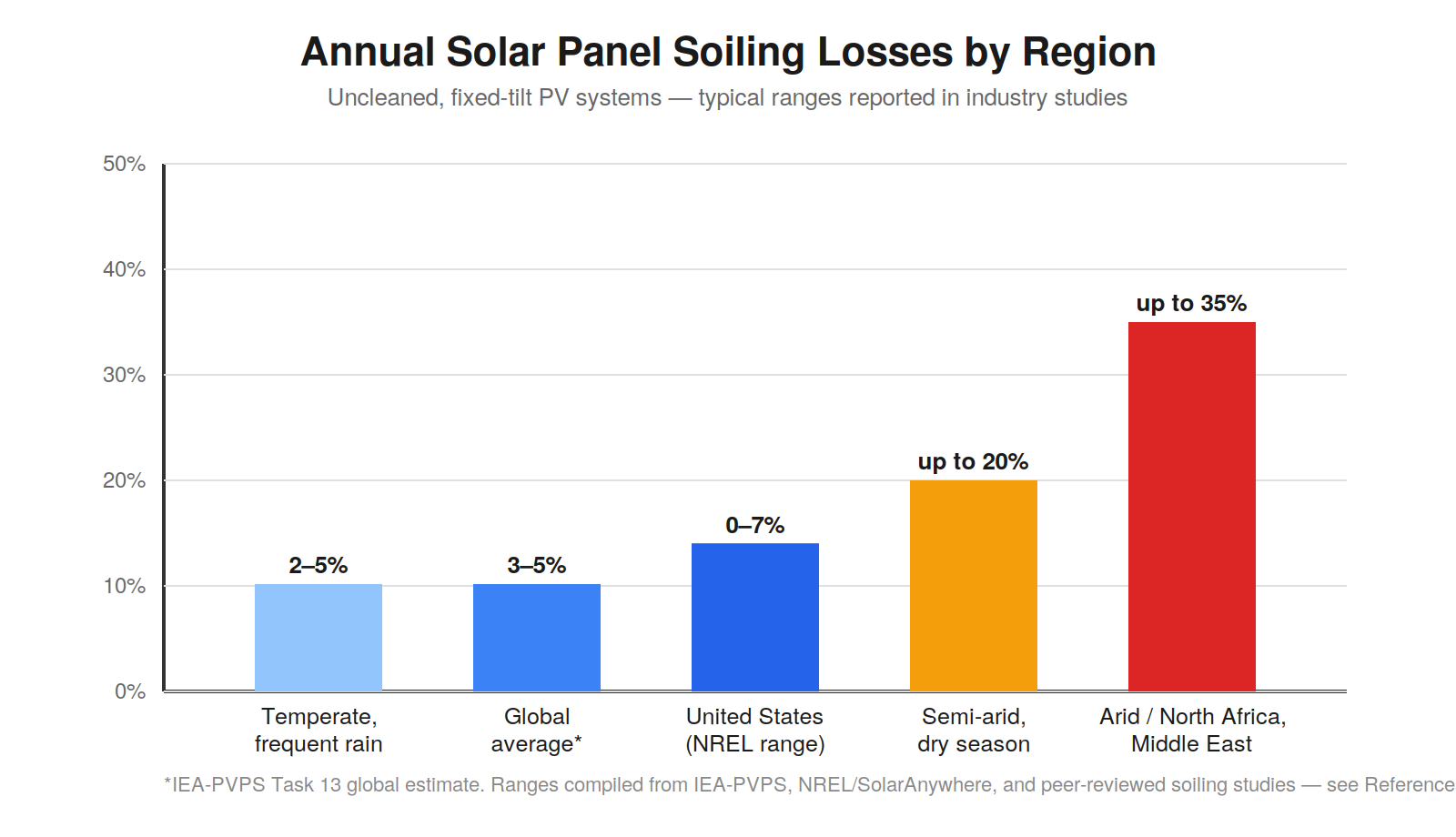
Solar panel cleaning sits at an odd intersection in PV operations: skip it and you lose energy to dust and dirt, but do it too often or too aggressively and you risk damaging the very modules you’re trying to protect. This article looks at what actually drives that decision: how much soiling really costs, how cleaning itself can go wrong, and how performance monitoring with Enectiva can help operators clean based on evidence rather than a fixed calendar. Solar panels are often described as low maintenance assets, but low maintenance does not mean no maintenance. Dust, pollen, bird droppings, industrial emissions, and other contaminants gradually accumulate on module surfaces and reduce the amount of sunlight reaching the solar cells. Globally, soiling is one of the most important environmental causes of photovoltaic underperformance. IEA-PVPS – the International Energy Agency’s Photovoltaic Power System Program, a collaborative research program where member countries share technical knowledge on solar PV has estimates that soiling can reduce annual PV energy production by roughly 3–5% globally [1], although the actual impact varies considerably according to climate, rainfall, pollution, module tilt, and local conditions.
The obvious solution seems simple: clean the panels, but there is another question that PV operators should ask: When does cleaning actually make economic and technical sense?
Dirty panels reduce production- but cleaning also has a cost
- The effect of soiling is highly site-specific. A rooftop near an industrial area may accumulate dust differently than a rural installation, while agricultural activity, pollen, bird populations, and traffic pollution can all influence the rate of contamination.
- Rain can remove a considerable amount of loose dirt, while long dry periods allow deposits to accumulate. The inclination of the modules also matters flatter modules generally experience greater soiling.
- This means that cleaning every PV installation on a fixed schedule — for example, every month or every three months — is not necessarily the most efficient approach.
- A plant may be cleaned just before heavy rainfall, resulting in unnecessary maintenance costs. Alternatively, production losses may already have become significant while the next planned cleaning is still weeks away. IEA-PVPS therefore highlights monitoring and forecasting as useful tools for optimizing cleaning schedules, including avoiding cleaning shortly before rainfall or expected dust events [1][2].
Can cleaning solar panels actually damage them?
Yes, when it is done incorrectly. Mechanical wiping or brushing can scratch or abrade the anti-reflective coating on module glass. Fraunhofer CSP also warns that cleaning can introduce risks such as corrosion and thermal shock: applying cold water to a very hot module can place stress on the glass and solar cells and may contribute to the widening of existing microcracks [3]. Cleaning chemicals are another concern, Fraunhofer researchers have specifically investigated the potential for some cleaning agents to damage photovoltaic glass coatings, frames, and other module components, and in the most severe cases measured performance losses of up to 5.6% from coating damage alone [4][5]. IEA-PVPS consequently recommends following the module manufacturer’s instructions and using suitable cleaning methods. Its O&M guidance notes that cleaning solutions should generally rely on demineralized water and mild detergents where appropriate [1].
There is therefore a balance- Too little cleaning can reduce energy yield, while excessive or incorrect cleaning can increase costs and potentially accelerate module damage. The goal should not be to clean as frequently as possible. The goal should be to clean when the expected recovered energy justifies the intervention.
From scheduled cleaning to data-driven cleaning
Instead of relying only on visual inspection or a calendar, operators can continuously monitor how the plant is performing and identify when production starts deviating from expected behaviour. This is particularly important because reduced PV production does not automatically mean dirty modules. The cause could also be:
- Inverter or string problems,
- Partial shading,
- Grid outages,
- Electrical faults,
- Unusually high module temperature,
- Weather conditions,
- Genuine module degradation. Cleaning panels without first understanding the cause may therefore spend money without solving the actual problem.
How Enectiva can help
Enectiva does not physically clean the solar panels. Its role is to provide operators with performance visibility and operational information needed to make better maintenance decisions. Enectiva can monitor and evaluate photovoltaic plant performance, integrate data from meters and inverters, detect malfunctions, and account for power fluctuations caused by seasonal and weather conditions. This creates several opportunities for smarter PV cleaning.
1. Detect unusual production losses
- Enectiva can continuously monitor PV production and make declining or abnormal performance easier to identify.
- If production remains below the expected pattern while irradiance and operating conditions are otherwise normal, soiling can become one of the causes that the maintenance team investigates.
- The important point is that monitoring helps operators identify when an inspection is justified, rather than automatically sending a cleaning team on a fixed date.
2. Separate cleaning problems from technical faults
- A sudden production drop is more likely to indicate an inverter trip, breaker problem, or another technical fault than gradual dust accumulation.
- Enectiva provides visibility into PV performance and technical parameters and can detect plant malfunctions. This helps maintenance teams investigate the right cause before taking action.
- Enectiva’s existing PV monitoring approach is aimed at improving plant availability and reducing the amount of time that systems operate below their potential.
3. Prioritize the sites that need attention
- For companies operating several rooftop PV systems, the challenge becomes even greater.
- Cleaning every plant simultaneously may be unnecessary and expensive. Centralized monitoring makes it possible to compare sites and prioritize those showing the largest abnormal performance losses. Enectiva supports portfolio-level dashboards and reporting for multi-site PV operation and maintenance. This can turn cleaning from a routine calendar activity into a performance-based maintenance decision.
4. Choose a better time to clean
- Environmental information can also contribute to the decision.
- If heavy rainfall is expected shortly, cleaning may be postponed. During a prolonged dry period with steadily falling performance, intervention may make more sense.
- IEA-PVPS specifically identifies production data, environmental parameters such as irradiance, temperature and rainfall, and historical operating data as inputs that can support predictive PV maintenance including planning module cleaning cycles [1][2].
5. Verify whether cleaning actually worked
- Monitoring is equally valuable after maintenance.
- If normalized PV production improves after cleaning, the operator gains evidence that soiling was contributing to the loss.
- If performance does not recover, the maintenance team knows that another problem may need investigation.
- Over time, these records can help establish how quickly a particular site becomes soiled and whether the current cleaning strategy is economically justified.
A smarter PV cleaning workflow
A practical approach could therefore look like this: ** “Monitor → Detect underperformance → Check weather and technical faults → Inspect the modules → Clean only when necessary → Measure the result” **
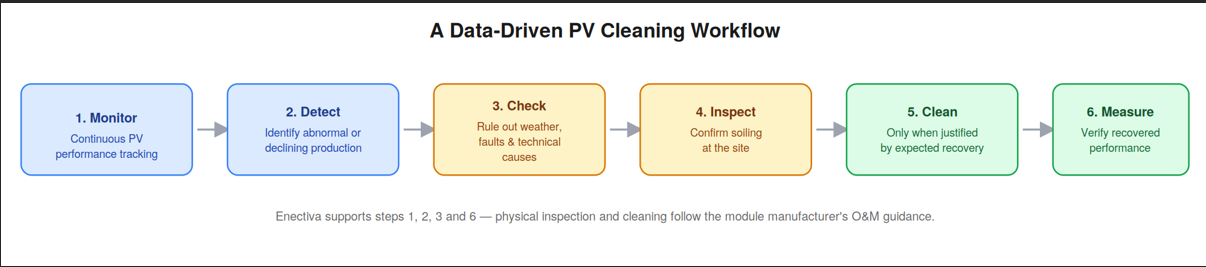
Enectiva supports the monitoring and evaluation part of this workflow, while physical inspection and cleaning should remain in accordance with the module manufacturer’s O&M recommendations. For larger commercial rooftop and utility-scale PV installations, this approach can reduce unnecessary site visits while helping operators react sooner when genuine production losses appear.
Clean based on performance, not only on the calendar
Solar module cleaning remains an important part of PV operation and maintenance. Soiling can reduce output, create localized shading, and, in severe cases, contribute to hot-spot risks. At the same time, cleaning itself should not be treated as a risk-free activity. Incorrect tools, aggressive chemicals, or unsuitable cleaning conditions can damage module surfaces and potentially worsen existing defects. The better strategy is therefore not simply “clean more often.” ** “Know when performance is being lost, understand why it is being lost, and clean when the recovered energy and avoided losses justify the intervention.” ** By providing continuous PV performance monitoring, malfunction detection, and centralized operational visibility, Enectiva can help turn solar panel cleaning from a fixed maintenance routine into a more informed, data-driven decision.
References
- IEA-PVPS Task 13, Soiling Losses – Impact on the Performance of Photovoltaic Power Plants (Report IEA-PVPS T13-21:2022). https://iea-pvps.org/key-topics/soiling-losses-impact-on-the-performance-of-photovoltaic-power-plants/
- IEA-PVPS, Fact Sheet: Understanding, Measuring, and Mitigating Soiling Losses in PV Power Systems. https://iea-pvps.org/fact-sheets/fs-soiling-losses/
- Fraunhofer IMWS, How Solar Module Soiling Impacts Yield — And How to Counter It. https://www.imws.fraunhofer.de/en/specials/how-solor-module-soiling-impacts-counter-it.html
- Fraunhofer IMWS, How Cleaning Agents Can Damage Photovoltaic Modules. https://www.imws.fraunhofer.de/en/presse/pressemitteilungen/2023/cleaning-agents-pv-pitting-corrosion.html
- pv magazine, Fraunhofer CSP Warns Some Cleaning Agents May Reduce PV Module Performance by Up to 5.6%. https://www.pv-magazine.com/2026/03/23/fraunhofer-csp-warns-some-cleaning-agents-may-reduce-pv-module-performance-by-up-to-5-6/
For more information or to get started, contact us directly at sales@enectiva.com or +420 222 766 950.